Mechanical Engineering
Home » UG Programme » Mechanical Engineering » About Department

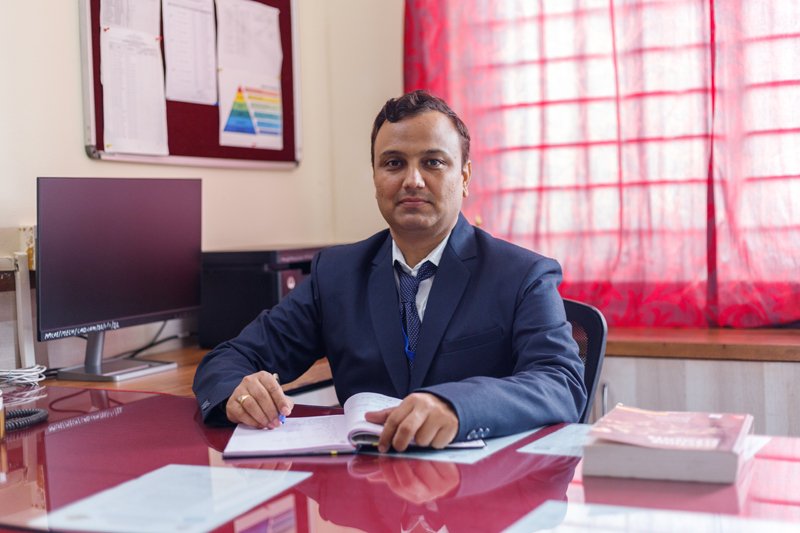
Head of Department of Mechanical Engineering
It gives me immense pleasure to welcome you to the Department of Mechanical Engineering at Marathwada Mitra Mandal’s College of Engineering (MMCOE), Pune. Since its establishment in 2006, the department has been committed to nurturing technically competent, socially responsible, and ethically strong engineers. With programs at the undergraduate, postgraduate, and working professionals’ levels, our department—affiliated with Savitribai Phule Pune University and accredited by the NBA—has grown into one of the most vibrant and dynamic departments in the region.
At the core of our academic philosophy lies a strong emphasis on Outcome-Based Education (OBE). We constantly strive to upgrade our teaching-learning methods to meet global standards, incorporating innovative practices and industry-relevant skills. Our students benefit from a unique blend of rigorous academics and hands-on experience through internships, industrial projects, and cutting-edge research exposure.
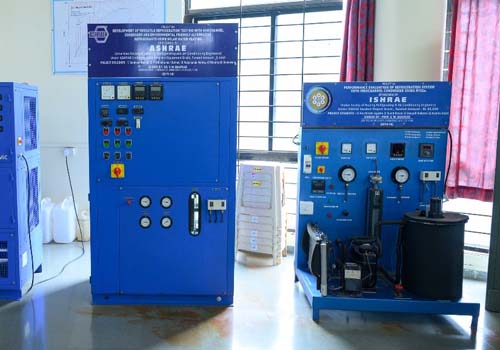
The department is home to vibrant student chapters such as SAEINDIA (BAJA, Supra, Effi-cycle), ISHRAE, ASHRAE, IE(I), ISTE, and others, which offer excellent platforms for students to develop their technical and leadership skills. These associations, along with our skill development programs, provide ample opportunities for experiential learning, teamwork, and innovation.
We take pride in fostering all-round development of our students—technically, professionally, and personally—preparing them to thrive in a rapidly evolving engineering landscape. With the emergence of new technologies like Artificial Intelligence, Machine Learning, IoT, Data Science, and Electric Vehicles, the traditional boundaries of mechanical engineering are expanding, opening up a diverse array of career paths.
We welcome all aspiring engineers to be a part of our journey of excellence, innovation, and societal impact.
Department Highlights
- Outcome-Based Education philosophy
- Academic Autonomy– Curriculum designed to meet industry standards
- Well-equipped laboratories with industry grade equipment
- Classrooms equipped with smart boards audio visual aids
- Qualified, Experienced and dedicated faculties and staff
- Industry funded Product Development Centre
- Academic excellence through curricular and extra-curricular activities
- Active participation in SAE India competitions BAJA, SUPRA, and EFFI CYCLE
- MOU’s with renowned organisations for Industrial Training & Internship and BE Projects
- National and international certifications, NPTEL courses
- IIT Bombay spoken tutorials on Arduino, python and Qcad
- Research Publications, patents and funded projects by faculties and students
- International collaborations for R & D activities
- Major Degree BE Mechanical with Honours in Data Science and Electric Vehicle.
- Alumni working across globe with International brands
Vision
To develop globally competent and socially committed mechanical engineers
Mission
Our Mission is to
- Develop competent professionals through center of excellence.
- Strengthen industry-academia collaboration for ethically responding real-world problems.
- Provide an inclusive environment for entrepreneurship, research and innovation.
- Empower students for higher education and lifelong learning .
Program Educational Objectives (PEOs)
Graduates from our program will:
PEO1:Apply professional skills for solving the problems in mechanical engineering & related fields.
PEO2:Demonstrate ethics and concern for society and the environment.
- PEO3:Embrace lifelong learning through higher studies, research and innovation.
Knowledge and Attitude Profile (WK)
Graduates from our program will:
PS0-I: Apply advanced technologies of mechanical and allied engineering to address the challenges faced in Industry 4.0.
PS0-II: Contribute to the project in the core and associated domain by using add-on skills like CAD, CAM and CAE.
PS0-III: Develop the ability to innovate socially relevant products and systems by effectively utilizing resources.
Programme Outcomes (POs)
A Graduate of the Computer Engineering Program will be able to
PO1: Engineering Knowledge: Apply knowledge of mathematics, natural science, computing, engineering fundamentals and an engineering specialization as specified in (WK1 to WK4) respectively to develop the solution of complex engineering problems.
PO2: Problem Analysis: Identify, formulate, review research literature and analyze complex engineering problems reaching substantiated conclusions with consideration for sustainable development. (WK1 to WK4)
PO3: Design/Development of Solutions: Design creative solutions for complex engineering problems and design/develop systems/components/processes to meet identified needs with consideration for the public health and safety, whole-life cost, net zero carbon, culture, society and environment as required. (WK5)
PO4: Conduct Investigations of Complex Problems: Conduct investigations of complex engineering problems using research-based knowledge including design of experiments, modelling, analysis & interpretation of data to provide valid conclusions. (WK8).
PO5: Engineering Tool Usage: Create, select and apply appropriate techniques, resources and modern engineering & IT tools, including prediction and modelling recognizing their limitations to solve complex engineering problems. (WK2 and WK6)
PO6: The Engineer and The World: Analyze and evaluate societal and environmental aspects while solving complex engineering problems for its impact on sustainability with reference to economy, health, safety, legal framework, culture and environment. (WK1, WK5, and WK7).
PO7: Ethics: Apply ethical principles and commit to professional ethics, human values, diversity and inclusion; adhere to national & international laws. (WK9)
PO8: Individual and Collaborative Team work: Function effectively as an individual, and as a member or leader in diverse/multi-disciplinary teams.
PO9: Communication: Communicate effectively and inclusively within the engineering community and society at large, such as being able to comprehend and write effective reports and design documentation, make effective presentations considering cultural, language, and learning differences
PO10: Project Management and Finance: Apply knowledge and understanding of engineering management principles and economic decision-making and apply these to one’s own work, as a member and leader in a team, and to manage projects and in multidisciplinary environments.
PO11: Life-Long Learning: Recognize the need for, and have the preparation and ability for i) independent and life-long learning ii) adaptability to new and emerging technologies and iii) critical thinking in the broadest context of technological change. (WK8)
Programme Specific Outcomes (PSOs)
- WK1: A systematic, theory-based understanding of the natural sciences applicable to the discipline and awareness of relevant social sciences.
- WK2: Conceptually-based mathematics, numerical analysis, data analysis, statistics and formal aspects of computer and information science to support detailed analysis and modelling applicable to the discipline.
- WK3: A systematic, theory-based formulation of engineering fundamentals required in the engineering discipline.
- WK4: Engineering specialist knowledge that provides theoretical frameworks and bodies of knowledge for the accepted practice areas in the engineering discipline; much is at the forefront of the discipline.
- WK5: Knowledge, including efficient resource use, environmental impacts, whole-life cost, re-use of resources, net zero carbon, and similar concepts, that supports engineering design and operations in a practice area.
- WK6: Knowledge of engineering practice (technology) in the practice areas in the engineering discipline.
- WK7: Knowledge of the role of engineering in society and identified issues in engineering practice in the discipline, such as the professional responsibility of an engineer to public safety and sustainable development.
- WK8: Engagement with selected knowledge in the current research literature of the discipline, awareness of the power of critical thinking and creative approaches to evaluate emerging issues.
- WK9: Ethics, inclusive behavior and conduct. Knowledge of professional ethics, responsibilities, and norms of engineering practice. Awareness of the need for diversity by reason of ethnicity, gender, age, physical ability etc. with mutual understanding and respect, and of inclusive attitudes.
Toppers List 2024-25
Second Year
Third Year
Final Year
Our Recruiters


Mechanical Engineering
Our Recruiters