
Reimagining Indian Higher Education: A Journey Through the Ages
[wpseo_breadcrumb]
It has been many years since I was wondering about the changing scenarios of Indian Higher Education. With the introduction of the New National Education Policy (NEP) 2020, it is indeed quite intriguing to know the fact that we are revisiting the higher education system and surprisingly we are discussing the ancient arrangement again. The new system also insists on the holistic development of the students. So, yes you might have understood by now that this First blog of my SERIES will sail us through the beginning of the Education set up in ancient India. So let us begin this journey…….
Imagine a beautiful sight, under the soothing shade of a tree a teacher shares his wisdom with his pupils, whether it is about life, nature, or even the universe. Learning or knowledge acquisition pretty much looked like this in ancient India. Yes, I am talking about the ‘Gurukul System’ in ancient India, an arrangement where a student would live with a guru for years, leaving his parental home. This system required the guru to be a mentor, a parent figure, a life guide all rolled into one; which was way beyond being a mere instructor. Education was oral but Practical based, no textbooks, no exams; which leads us to an understanding that students learned Vedas – ancient texts covering everything from philosophy and medicine to astronomy and governance through deep conversation, memorization, and debate. These interactions build a sacred and strong bond between teacher and the student. Thus, learning was a way of life, not just a means to a job. A culture that emphasized the development of all dimensions of humanity with an emphasis on living in harmony with oneself, one’s environment, and the universe at large
This brings us to an understanding that the concepts of Higher Education that are revamping, and are getting revisited by the NEW EDUCATION POLICY 2020(NEP), had already been implemented during the Vedic Period in India.
LEARNING by doing, insisting on the Holistic Development of the students, had been the CORE of Indian education system since the Vedic era where learning extended beyond textbooks and moreover focused on character formation, ethical values, discipline, and self -realization. Similarly, NEP echoes this philosophy through EXPERIENTIAL and Skill Based Learning, continuous guidance, mentorship and above all interactive learning environments.
This takes me back to The Golden Age — Ancient Universities, especially talking about Takshashila and Nalanda, an apt example of “A Model of Global and Interdisciplinary Learning.” There were no classrooms but some of the world’s first and rather finest universities existed then, that too centuries before Oxford or Cambridge were not even imagined. The ancient Nalanda University, flourished between the 5th and 12th Century, was among the world’s earliest International Residential Universities. International Students from China, Babylon, Greece, and Arabia came all the way to India to study medicine, law, military science, and philosophy. It was essentially an ancient version of an international campus in the true sense of it. Nalanda** — the crown jewel of ancient learning. had over 10,000 students and 2,000 teachers at its peak. It had a massive library called *Dharmaganja* (Treasury of Truth) spread across nine floors. Students studied logic, grammar, medicine, mathematics, and Buddhist philosophy. Admission was competitive — not everyone got in.
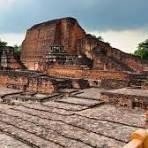
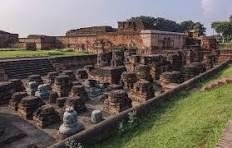
Nalanda Dharma Ganj Ancient Nine Storeyed Library
The Indian education system is undergoing a major transformation with the implementation of the new National Education Policy (NEP), 2020. Although the policy insists on the Outcome Based Education System which looks toward the future, eventually it seems that it has drawn inspiration from India’s rich educational heritage. This brings us to an understanding that the Goals of Modern Higher education under NEP strongly resonate with the ancient Vedic Education System and the globally acclaimed Nalanda University.
The most astounding thing about Indian higher education is the incredible continuity beneath all the change. From the guru sitting under a peepal tree to a professor on a Zoom call, the yearning or the desire to seek knowledge and wisdom has never left this land of stalwarts of education.
The alignment between the ancient wisdom of the Indian educational system and the futuristic vision of the NEP2020 blends the Holistic wisdom of the Vedic system and the international multidisciplinary outlook of Nalanda University. This paves the way towards creating the Indian higher education system both globally Competitive and deeply rooted in its cultural ethos.
So with this let us ponder a little more on the changing (or not so changing ) concept of higher education in India since ancient times in my upcoming blog.
Dr Sachin Sakhare, Principal,
Marathwada Mitra Mandal’s college of Engineering, Pune
linkedin.com/in/dr-sachin-s-844084bb