
From Curiosity to Clarity: Exploring Deep Learning Together
[wpseo_breadcrumb]
One day during a regular college lecture, a few students stopped me with a question that seemed simple but carried a lot of depth: “Ma’am, how does a phone recognize our face so quickly? And how do chatbots understand what we are saying as if they are humans?” It wasn’t part of the planned lecture, but it turned into one of the most engaging discussions we had. Moments like these remind me that real learning often begins with curiosity.
I explained to them that what they were experiencing is powered by deep learning, a branch of artificial intelligence that allows machines to learn from data instead of being explicitly programmed step by step. Unlike traditional methods where we define rules for every situation, deep learning systems learn patterns on their own. For example, instead of telling a machine what eyes, nose, and lips look like, we provide it with many images, and it gradually learns to recognize faces by identifying patterns within that data. This ability to learn directly from raw information is what makes deep learning so powerful.
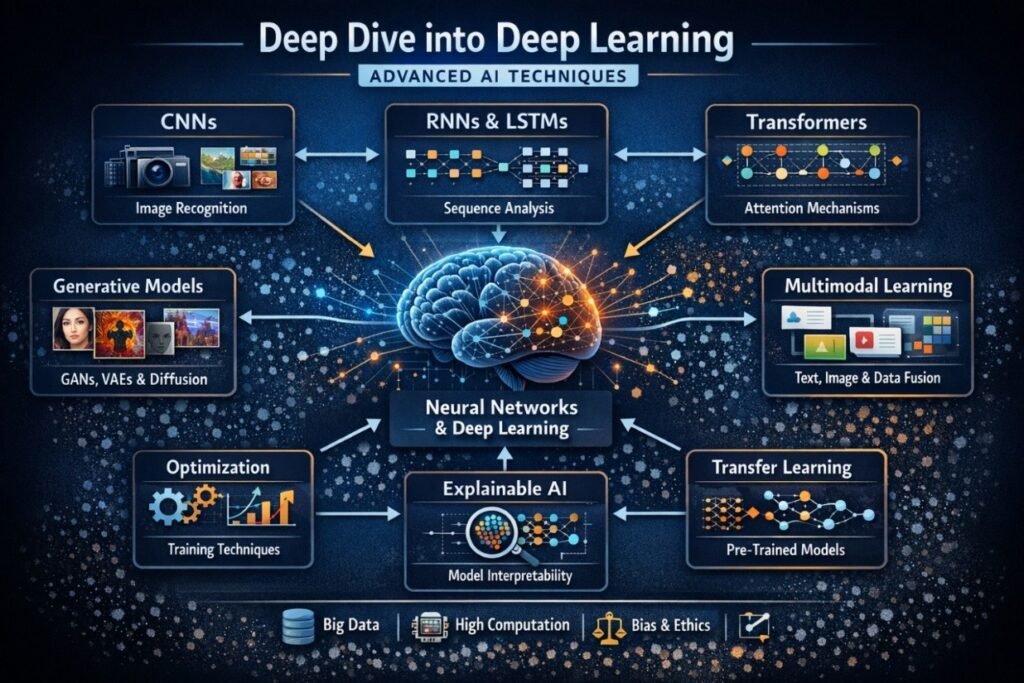
As the conversation continued, I could see their interest growing. Many of them assumed this technology was something very recent, but in reality, it has evolved over time. Earlier models like Convolutional Neural Networks helped computers understand images, while Recurrent Neural Networks and LSTMs were used to process sequences like text and speech. But the real shift happened with the introduction of transformer models. These models brought in the concept of attention, which allows systems to focus on the most relevant parts of the data. Because of this, machines are now better at understanding context, which is why modern applications feel more natural and responsive.
At one point, a student asked, “So can machines create something new on their own?” That question always brings excitement. I told them that today’s systems are not just limited to understanding data—they can also generate it. There are models that can create images, write text, and even simulate real-world scenarios. This has opened doors to applications in design, content creation, and research. It is fascinating to see machines moving from analysis to creativity.
However, I also made sure they understood that behind all this capability lies a lot of effort. Training deep learning models is not just about running code. It involves choosing the right techniques to ensure the model learns properly. Methods like normalization and dropout help improve performance, while optimizers guide how the model updates itself during learning. Small changes in these settings can lead to big differences in results, which is why building good models often requires patience and experimentation.
As we went deeper into the topic, another student raised a very important concern: “If machines are making decisions, how do we know they are correct?” This is where the idea of explainability becomes important. We need ways to understand how a model reaches a decision, especially in areas like healthcare or finance where mistakes can have serious consequences. Building trust in AI systems is just as important as building the systems themselves.
We also discussed how deep learning is moving forward with new ideas like combining different types of data—text, images, and structured information—to get better insights. At the same time, the use of pre-trained models has made it easier to develop applications without starting from scratch. These advancements are helping more people work with deep learning, even if they don’t have access to massive resources.
Still, I didn’t want to give them the impression that everything is perfect. Deep learning comes with its own set of challenges. It requires large amounts of data, powerful hardware, and careful attention to avoid bias in results. These are real concerns, and addressing them is necessary if we want to build systems that are fair and reliable.
By the end of the discussion, what started as a casual question turned into a meaningful learning experience. Deep learning is no longer something limited to research labs—it is all around us, influencing how we communicate, work, and interact with technology. From unlocking our phones to assisting in medical decisions, it has become a part of everyday life.
Before wrapping up, I shared one final thought with them. Deep learning is not just about making machines smarter; it is about expanding what machines are capable of doing. Some of today’s models are trained on such vast amounts of data that it would take humans an unimaginable amount of time to process it manually. And yet, these systems can learn from it efficiently.
That day, the lecture ended, but the discussion stayed with them—and with me. Because in reality, deep learning is still growing, and so is our understanding of it. The more we explore, the more we realize how much there is still to discover because “Deep learning is not just about building intelligent systems—it’s about continuously expanding the limits of what machines can understand and achieve.”
Ms. Punam V. Chavan
Assistant Professor
Department Of Information Technology
MMCOE, Pune
punamchavan@mmcoe.edu.in